
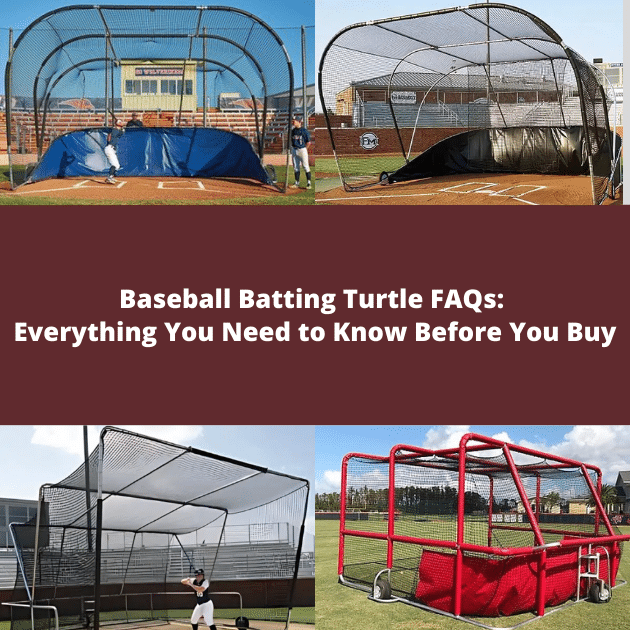
TL;DR: A batting turtle is a portable, self-contained batting cage on wheels that sets up in 3 to 5 minutes and handles daily professional use. Models range from $3,950 to $10,900 with free shipping to schools and businesses. Frames last 15 to 20-plus years with minimal monthly maintenance.
What Is a Batting Turtle?
A batting turtle is a portable, self-contained batting cage built on a wheeled aluminum frame that coaches can move, set up, and fold down without tools or a crew. The name comes from the shape: when the cage is folded down for storage or transport, it sits low and wide like a turtle shell. When it is open for use, it forms a full enclosure around the hitter, pitcher, and pitching machine.
Unlike permanent cages bolted to a wall or hung from a ceiling, a batting turtle lives outdoors on your field and rolls where you need it. You are not locked into one spot. You can rotate hitting stations, clear the field for a game in minutes, and store the unit in a corner of your facility during the off-season.
Standard batting turtles include a heavy-wall aluminum frame, a knotless netting system, wheels for mobility, full frame padding, a thud pad behind the hitter, and a vinyl skirt at ground level. Models range from compact single-hitter units to large professional cages. You can browse the full lineup on the portable batting turtle collection page.
What Is a Turtle in Baseball?
In baseball, a turtle refers to a portable batting cage unit that coaches wheel onto the field for batting practice and fold down flat when practice is over. The term is widely used by coaches, athletic directors, and facility managers across high school, college, and professional programs. It is not slang for a player or a play type. It is specifically the portable cage equipment category that Baseball Turtles pioneered. When a coach says “roll out the turtle,” the whole team knows it is time for batting practice.
Essential Guide for Baseball Coaches: What You Need to Know Before You Buy
Before you invest in a portable batting cage, every coach should understand five core factors: size, portability, net quality, total cost of ownership, and how the unit fits your practice workflow.
Size: Plan on a cage footprint of roughly 22 feet long by 18 feet wide by 12 feet tall for a full-size unit, with a total cleared area of at least 40 by 35 feet so coaches and players can work safely around the outside of the cage.
Portability: One to three people can move a batting turtle. Setup runs 3 to 5 minutes once your crew knows the routine. That matters when you have a doubleheader or need to clear the field fast.
Net quality: The two main choices are #42 and #60 knotless netting. Higher numbers mean heavier, more durable netting. Programs running daily high-velocity batting practice should lean toward #60 netting. Both options are available through the parts and accessories section.
Total cost of ownership: A frame that lasts 15 to 20-plus years at roughly $600 per year in total cost of ownership makes a batting turtle one of the best long-term equipment investments a program can make, especially when you factor in the baseballs you stop losing.
Workflow fit: Think about where you store equipment, how many stations you run at once, and whether you need the cage primarily on a grass field, turf, or both. Different models serve different workflows. The buying guides and practice strategy resources can help you match a model to your program’s actual needs.
Popular models worth reviewing:
- Singles Hitter Portable Batting Cage for compact single-station setups
- Home Plate Portable Hitting Cage for full home plate experience
- Doubles Hitter Portable Batting Turtle for running two hitters simultaneously
- Roll-Away Batting Cage for programs prioritizing ease of movement
- Pitch Hunter Express for fast-setup high-volume programs
- Pitch Hunter Batting Turtle for full pitching machine integration
- Big Bubba Batting Cage Turtle for maximum size and protection
- New Pro Turtle for programs that want all features included with no hidden upgrade costs
How Much Does a Batting Turtle Cost?
Batting turtles range from $3,950 to $10,900 as of 2026, depending on size, features, and net quality. Ongoing tariff and supply costs continue to push prices up slightly, so current pricing on each product page is the most reliable source.
| Tier | Price Range | What You Get |
|---|---|---|
| Budget | $3,950 to $4,950 | Basic features, smaller frames |
| Mid-Range | $6,900 to $8,500 | Full-size with professional features |
| Premium | $8,200 to $10,900 | Maximum protection, all upgrades included |
What drives the price:
- Frame size and tube diameter (typically 2-inch heavy-wall aluminum)
- Net grade (#42 vs. #60 knotless netting)
- Included features such as coaching platforms, full-frame padding, and thud pads
- Wheel type (wide turf tires vs. standard wheels)
- Color customization options
A note on comparing prices: A $6,900 cage that includes all features can easily outperform a $5,500 cage where you spend $2,000 or more on necessary upgrades after the fact. Look at total delivered cost, not just the base price.
Shipping: Free shipping is included to any school or business in the continental United States for most models. Residential delivery is not recommended and will cost extra.
Payment options accepted:
- Purchase orders from schools and organizations
- Credit cards (Visa, Mastercard, Amex, Discover) with a 3% processing fee
- Business, school, or booster club checks
- Wire transfers and certified checks
- Split payment through PayPal-type services in the shopping cart
Schools and tax-exempt organizations can use the “Add to Quote” button on any product page, then email coach@baseballturtles.com with the purchase order, tax-exempt certificate, and delivery address. An invoice typically comes back within 24 hours.
How to Set Up a Hitting Turtle in Your Backyard
Setting up a batting turtle in your backyard takes 3 to 5 minutes once you know the routine and follows the same steps as any field setup. You need a flat, clear area of at least 40 by 35 feet, one to three people, and no tools.
Basic setup steps:
- Roll the unit to the desired location on its wheels.
- Unlock the frame and extend the ribs outward to the open position.
- Secure the net panels to the frame at the connection points.
- Confirm the thud pad is properly positioned behind the hitter’s area.
- In winds above 20 mph, anchor the unit using the provided anchor points before use.
Full step-by-step assembly instructions for every model are available on the assembly instruction manuals page. If you hit a snag, call 828-820-8644 and walk through it with someone who has assembled these units hundreds of times.
Backyard-specific tips:
- Check your local ordinances on outdoor structures before setting up permanently.
- Avoid positioning the open end of the cage toward a neighbor’s property or a road.
- Store the unit in the folded position during extended periods of non-use to protect the net from UV exposure and wind abrasion.
- If you leave the unit up through winter, expect to replace the net sooner than the 3 to 5-year average.
How to Make a Homemade Batting Cage vs. Buying a Batting Turtle
You can build a basic homemade batting cage from PVC pipe, conduit, or wood framing combined with a purchased net, but for any program running serious daily batting practice, a purpose-built batting turtle will outperform and outlast a DIY cage in nearly every way.
| Factor | Homemade Cage | Batting Turtle |
|---|---|---|
| Setup and teardown | 30 to 60 minutes, multiple people | 3 to 5 minutes, 1 to 3 people |
| Portability | Not portable without full disassembly | Rolls anywhere on your field |
| Durability | PVC or wood degrades quickly outdoors | 2-inch heavy-wall aluminum, 15 to 20-plus year frame life |
| Safety at high velocity | Not rated for 100-plus mph exit velocity | Designed for 100-plus mph exit velocities |
| True total cost | Low upfront, high ongoing repair cost | Roughly $600 per year over the frame lifespan |
| Net replacement | Custom fitting required | Direct replacement parts in stock |
| Warranty | None | 5-year frame warranty |
If your program is at the high school, travel ball, college, or professional level and you run batting practice daily, a homemade cage is a short-term workaround, not a long-term solution. The Big Bubba parts are available separately if you ever need to supplement or repair your setup through the Big Bubba batting cage parts page.
How to Maintain and Store Your Batting Turtle for Maximum Longevity
Maintaining a batting turtle takes about 15 minutes per month and storing it properly in the off-season can double your net’s lifespan from 3 to 5 years to 6 to 10 years.
Monthly maintenance checklist:
- Inspect the net for holes larger than a softball, fraying around high-impact zones, or significant sagging and stretching.
- Check all hardware connections, bolts, and U-lock connector tubes for tightness.
- Look over wheels and turf tires for wear and make sure they roll freely.
- Inspect frame padding, thud pad, and vinyl skirt for tears or separation.
- Clean any debris from the net panels and frame.
Off-season storage:
- Fold the cage into its turtle position and bring it indoors or under cover.
- Avoid leaving the unit in the upright open position through winter. Cold wind is abrasive to netting and UV exposure shortens net life significantly.
- Store nets loosely rather than compressed tight over long periods.
Net lifespan factors:
- Daily use wears nets faster than two to three sessions per week.
- Dimpled practice balls are gentler than leather game balls.
- Higher exit velocities from high school and college hitters create more wear than youth hitters do.
- UV rays and winter wind are the two biggest enemies of netting.
Pro tip: Order your replacement net before you need it. Keep one in storage so you are never stuck mid-season without your cage. Cut up the old net and use pieces to patch screens or hang an 8 by 8-foot or 10 by 10-foot section loosely behind your cage to protect the highest-impact area and extend the main net’s life even further.
Vinyl skirt lifespan: Expect 5 to 7 years. It outlasts the net because it takes less direct ball impact. Replace it when you see cracking, separation from the frame, or sections that no longer sit at ground level properly.
All replacement parts including nets in both #42 and #60 knotless, vinyl skirts in team colors, thud pads, rib cushions, frame padding, wheels, turf tires, U-lock connector tubes, and hardware kits are stocked and available through the batting cage parts and accessories page.
Pricing and Purchasing Questions
Is there a warranty?
All batting turtles come with a 5-year frame warranty covering tube defects, welding failures, and structural issues. Nets, vinyl skirts, padding, and wheels are normal wear items and are not covered. No extended warranty is offered because the frames genuinely last and an extended plan would cost most buyers more than they would ever recover.
What is the return policy?
All orders are considered custom and are not returnable. Baseball Turtles has been building these units since 1999 and has never received a refund request, which reflects the time the team invests in pre-purchase conversations to make sure every buyer gets the right unit. If your shipment arrives damaged or defective, contact the team within 7 days of delivery. Inspect everything at delivery before signing off, because manufacturer and shipper liability ends at sign-off.
Parts and Maintenance: Detailed Questions
Where do I get replacement parts?
All replacement parts are stocked and available directly through Baseball Turtles. Visit the batting cage parts and accessories page or call 828-820-8644 Monday through Friday, 10 a.m. to 7 p.m. Eastern, and someone will help you identify exactly what you need.
Quick Recap
- A batting turtle is a portable, wheeled batting cage that sets up in 3 to 5 minutes without tools.
- The name comes from the low, wide shape of the unit when folded down for storage or transport.
- Prices range from $3,950 to $10,900 as of 2026, with free shipping to schools and businesses in the continental United States.
- Frame life runs 15 to 20-plus years; total cost of ownership is roughly $600 per year.
- Nets typically last 3 to 5 years under daily use and can last 6 to 10 years if you bring the unit indoors each off-season.
- Monthly maintenance takes about 15 minutes and covers net inspection, hardware checks, and wheel condition.
- All replacement parts are stocked and available directly through Baseball Turtles.
- Schools and tax-exempt organizations can use purchase orders and submit tax-exempt certificates by emailing coach@baseballturtles.com.
- Setup instructions for every model are on the assembly instruction manuals page.
- The New Pro Turtle is the most popular choice for programs that want all features included with no hidden upgrade costs.
- Buying guides and practice strategy resources are available at the buying guides page.
Frequently Asked Questions
How long does it take to set up a batting turtle?
Setup takes 3 to 5 minutes once your crew knows the routine. One to three people can move and open the unit with no tools required.
Can a batting turtle handle 100-mph exit velocities?
Yes. Batting turtles are designed for 100-plus mph exit velocities. In winds above 20 mph, anchor the unit before use.
What size area do I need for a batting turtle?
Plan on a minimum of 40 by 35 feet of total cleared area. The cage itself runs approximately 22 feet long by 18 feet wide by 12 feet tall for a full-size unit.
Do batting turtles work on both grass and turf?
Yes. The wheels are designed to roll across both natural grass and artificial turf. Wide turf tires are available for softer or more heavily used surfaces.
What is the difference between #42 and #60 knotless netting?
The number refers to the weight of the netting. #60 is heavier and more durable. Programs running high-velocity daily batting practice should consider #60 netting for longer life between replacements.
Can I order a batting turtle with my school’s colors?
Color customization is available on many models. Contact the team at coach@baseballturtles.com or call 828-820-8644 to confirm options for the specific model you are considering.
How do I know which batting turtle model is right for my program?
The buying guides page covers the key decision points. For a direct recommendation based on your program’s size, surface, and practice schedule, call 828-820-8644 and talk through it with someone who has helped programs at every level make this decision.
Ready to Choose the Right Model for Your Program?
You have the facts. You know what a batting turtle costs, how long it lasts, what maintenance looks like, and which questions to ask before you buy. The next step is matching the right model to your specific program.
Give us a call at 828-820-8644 Monday through Friday, 10 a.m. to 7 p.m. Eastern. You will reach someone who has personally worked through every one of these questions with coaches and athletic directors across the country. You can also email coach@baseballturtles.com anytime or browse the full lineup on the portable batting turtle collection page.