
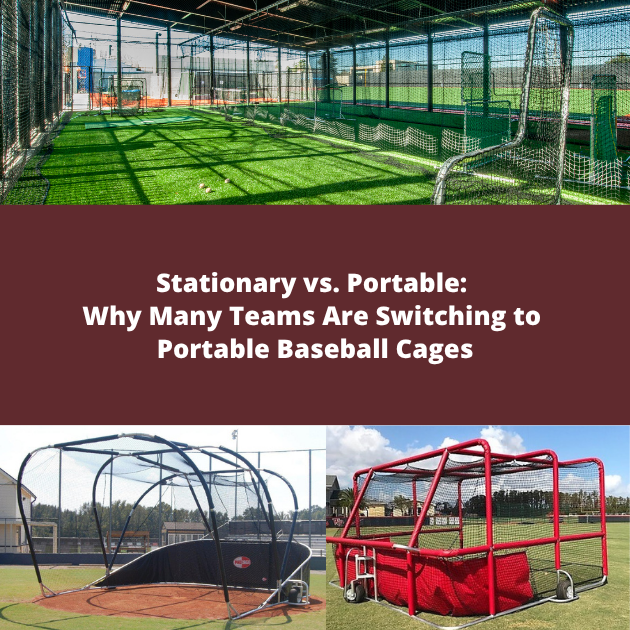
🎯 Quick Summary
Teams are switching from stationary to portable baseball cages for flexibility, efficiency, and cost savings. Portable batting practice cages offer superior mobility (roll anywhere on field), space efficiency (no permanent footprint), and player safety (store when not in use). They eliminate installation costs, construction permits, and concrete footings while providing heavy-wall steel construction and turf-protecting wheels. Key advantages: faster practice flow = more reps, one cage serves multiple teams, perfect for shared/limited-space facilities, and ideal for turf fields. Modern programs choose portable cages for adaptability—equipment that adjusts to your program rather than forcing your program to work around fixed structures. Explore portable batting cage options here.
When it comes to improving player performance, every coach knows that consistency, reps, and versatility make the biggest difference. But the equipment you use can either elevate your training sessions—or limit them. That’s why more teams are rethinking the traditional stationary batting cage and shifting toward a portable baseball cage that gives them far more flexibility, efficiency, and value.
In this guide, we’ll break down why this change is happening nationwide, compare the real differences between a stationary cage and a portable hitting cage, and help you decide whether switching to a portable batting practice cage is the right call for your program.
Table of Contents
Why Stationary Cages Have Been the Standard for So Long
For decades, stationary batting cages were the norm. Programs installed them behind fields, next to dugouts, or in dedicated practice spaces. And to be fair—stationary cages do have benefits:
-
They stay fixed in place
-
They require little setup
-
They tend to be made with heavy, permanent materials
-
They give players a consistent training space
However, baseball and softball programs have changed dramatically over the past ten years. Space is harder to come by. Multi-sport fields are more common. Teams travel more often. Urban schools have limited real estate. Even large facilities want more modular training areas.
Stationary cages simply aren’t designed for modern baseball environments.
⚾ The Rise of the Portable Baseball Cage
As programs evolved, so did their equipment needs. The portable baseball cage became the solution that solved nearly every problem stationary units created.
Today, coaches want:
-
More practice flexibility
-
Faster transitions during drills
-
Equipment that works in multiple locations
-
Something players can help move
-
A cage that doesn’t require major maintenance
-
A solution that saves space
A portable hitting cage checks every box.
Instead of being locked to one area, coaches can roll a mobile cage directly onto the field, create pop-up practice stations, or push it out of the way when the field is needed for other sports. This is the exact reason many college and high-school programs have already made the switch.
🔹 Stationary vs. Portable: Key Differences You Need to Understand
Let’s break down the major differences so you can compare both options clearly.
1. Mobility & Versatility
Stationary cages:
-
Locked into a permanent location
-
Cannot be moved for field changes or events
-
Often limits practice flow
Portable batting practice cage:
-
Rolls anywhere on the field
-
Opens up multiple training configurations
-
Allows more station-based practice
-
Easy to reposition as drills change
The ability to move your cage increases reps, improves pacing, and reduces downtime between drills or teams.
2. Space Requirements
Stationary cages demand a dedicated space, usually 60–70 feet long. Many programs don’t have that space available—or they need that space for other sports.
A portable hitting cage requires no permanent footprint. Just roll it out when needed and push it away when you’re done. This flexibility alone is why so many athletic directors are switching.
3. Player Safety & Field Management
Stationary cages can take up sideline or foul-territory space, occasionally interfering with games or practices.
A portable baseball cage eliminates that problem completely. You can store it:
-
Behind the dugout
-
Along the outfield wall
-
In an equipment garage
-
Off to the side during games
This keeps fields clean, safe, and professional-looking.
4. Durability & Construction Differences
Many people assume portable cages are less durable than stationary ones—but the opposite is true for well-engineered turtle-style cages.
A high-quality portable batting practice cage is typically built with:
-
Heavy-wall steel tubing
-
Reinforced joints
-
A full wraparound net
-
Weighted base frames
-
Turf-protecting wheels
These units are built to be moved daily, so they are engineered for toughness. They are also designed to absorb thousands of impacts from baseballs or softballs.
Stationary cages may rust, sag, or degrade because they’re exposed constantly to outdoor weather conditions.
5. Cost Effectiveness
Stationary cages usually require:
-
Construction
-
Installation
-
Concrete footings
-
Long-term maintenance
A portable baseball cage eliminates all of these costs.
For many programs, that alone makes the choice obvious.
💡 Why Teams Are Choosing Portable Baseball Cages More Than Ever
The trend is undeniable—youth leagues, colleges, high schools, training facilities, and even professional teams are choosing portability over permanence.
Here are the most common reasons coaches give:
Better Practice Flow = More Reps
A portable cage lets you position hitting stations anywhere on the field. That means:
-
Less standing around
-
More small-group instruction
-
More controlled reps
-
Faster setup and takedown
More reps always equal better player development.
One Cage Serves Multiple Teams
Coaches no longer need multiple stationary cages in multiple locations. One well-built portable hitting cage can serve baseball, softball, JV, varsity, and travel teams all in the same day.
It’s the most efficient use of equipment dollars.
Perfect for Limited-Space or Shared-Space Facilities
Schools that share fields with football, soccer, or lacrosse teams can’t afford to leave a bulky stationary cage in the way.
A portable baseball cage rolls off the field in minutes, keeping everyone happy.
Ideal for Turf Fields
Modern athletic complexes increasingly use turf—and turf requires protection.
Our portable cages include wheels engineered to protect turf during movement, something stationary cages can’t offer.
No Construction Permits, No Permanent Modifications
Administrators love portable cages because they avoid:
-
Permits
-
Approvals
-
Permanent field changes
-
Long installations
They simply arrive, assemble once, and are ready to use forever.
✅ Portable Batting Practice Cage Benefits That Make the Biggest Difference
Let’s highlight the benefits coaches mention most often when upgrading to a portable turtle-style cage.
✔ 360° Player Protection
The wraparound structure keeps both athletes and coaches safe from ricochets and foul balls.
✔ Weather-Resistant Durability
Portable cages are purposely designed to endure heavy use outdoors without the long-term wear stationary cages experience.
✔ Faster Setup, Less Hassle
Roll it into position. Lock the wheels. Start hitting.
That’s it—no prep, no assembly, no waiting.
✔ Improves Practice Efficiency
Being able to instantly move the cage:
-
Speeds up drills
-
Keeps players engaged
-
Allows creative training setups
-
Enhances practice flow
Coaches consistently report a noticeable increase in productivity with a portable batting practice cage.
✔ Long-Term Cost Savings
Because portable cages require less maintenance and no installation costs, the total lifespan value is significantly higher than most stationary solutions.
Which One Is Right for Your Program?
Here’s a simple breakdown:
Choose a Stationary Cage if:
-
You have ample permanent space
-
You don’t need mobility
-
You prefer a fixed practice layout
Choose a Portable Batting Practice Cage if:
-
You need flexibility
-
You share fields with other sports
-
You want faster practices
-
You want the most reps with the fewest obstacles
-
You need equipment that adapts to your program—not the other way around
For most modern programs, the portable option delivers the highest performance, value, and convenience.
Final Thoughts
Teams are switching to portable baseball cages for one reason: they solve the training challenges today’s coaches face. A well-built portable hitting cage gives you unmatched flexibility, saves time, protects your field, and delivers the durability coaches depend on.
If your program is looking to increase reps, simplify practices, and operate more efficiently, upgrading to a portable design is a smart long-term investment.
📞 Talk to the Portable Batting Cage Experts
Still deciding which portable turtle batting cage is right for your program?
We’re here to help.
➡️ Call us today at 828-820-8644
➡️ Or Request a Quote for tax-exempt organizations
Our team will help you find a model that matches your budget, training goals, and storage needs — because the right equipment makes all the difference in your team’s success.