
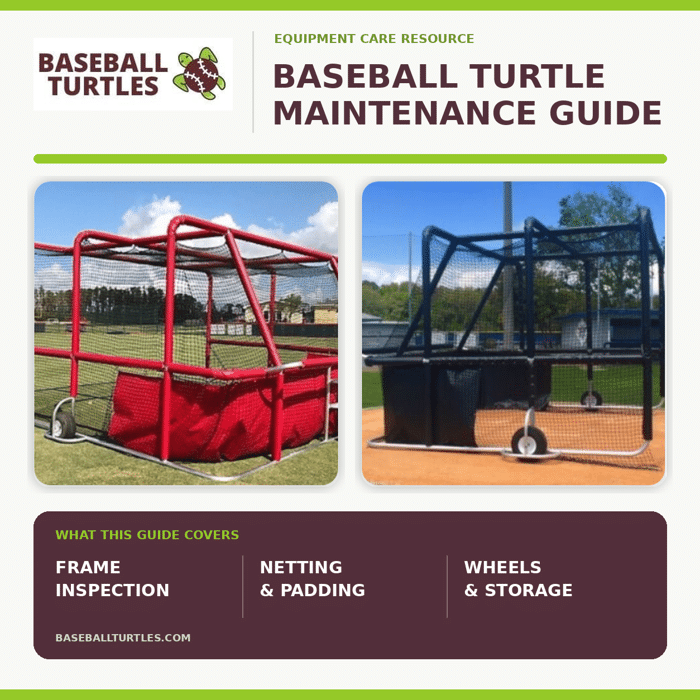
A portable baseball turtle is a working piece of practice equipment. It gets rolled onto fields, positioned for hitting sessions, exposed to weather, and used repeatedly throughout the season. Keeping it in good condition requires more than an occasional cleaning.
For athletic directors, coaches, and equipment managers, a practical maintenance routine helps identify worn components, preserve equipment functionality, and plan repairs before problems interrupt scheduled batting practice. This guide explains how to inspect, clean, maintain, and store baseball turtles and portable batting backstops.
How Do You Maintain a Baseball Turtle?
Maintain a baseball turtle by inspecting its frame, fasteners, netting, padding, and wheel assemblies before use. Remove debris, clean materials according to the manufacturer’s instructions, and check moving components regularly. Address damaged parts promptly, follow model-specific assembly and maintenance guidance, and inspect the entire unit before returning it to service after storage or repairs.
TL;DR: Baseball Turtle Maintenance Essentials
- Before practice: Check structural connections, netting, padding, and wheels.
- During the season: Remove accumulated dirt and inspect high-wear components.
- Before storage: Clean and dry the unit, document existing damage, and protect it from avoidable exposure.
- When repairs are needed: Identify the exact model and use compatible replacement parts.
Table of Contents
Why Regular Maintenance Matters
Unlike a permanently installed batting cage, a portable baseball turtle must withstand both repeated ball contact and regular movement around a practice facility. Its frame, netting, protective coverings, and transport components all contribute to its operation.
For schools and organized athletic programs, an equipment problem can affect practice schedules, maintenance budgets, and field operations. Routine inspection makes it easier to identify issues while they are still manageable.
Maintenance requirements differ by equipment design. A folding batting turtle may have additional joints or moving connections, while a rigid-frame model may have fewer folding mechanisms. Wheel assemblies, net attachments, and protective components also vary by manufacturer and model.
That is why Baseball Turtles provides model-specific assembly instruction manuals. Those documents should guide any maintenance or adjustment that depends on the equipment’s construction.
Pre-Practice Inspection Checklist
A short visual and functional inspection before batting practice can identify obvious problems without requiring a complete disassembly. Assign the task to a responsible staff member familiar with the equipment and its operating instructions.
Inspect the Frame and Connections
Start with the primary structural members. Look for visible bends, cracks, damaged welds, corrosion, or connections that appear out of alignment.
Check accessible bolts, clamps, locking mechanisms, and other fasteners for obvious looseness or damage. Do not tighten hardware indiscriminately; use the manufacturer’s specified procedures and hardware requirements.
Pay additional attention to connections that move during folding, unfolding, or transport. If a mechanism does not operate normally, stop and determine why rather than forcing it into position.
Examine Netting and Protective Components
Inspect the main batting cage net for holes, fraying, damaged attachment points, or sections that have shifted from their intended positions.
Where the model includes a separate baffle net, examine that component as well. Baffles are positioned to receive repeated ball contact and should remain properly attached and free from significant damage.
For more detailed guidance on identifying damage and deciding when replacement is necessary, see our portable batting cage net replacement guide.
Check vinyl skirts, ricochet cushions, and protective padding for tears, loose attachments, or exposed areas. These materials may need attention even when the metal frame remains in good condition.
Check Wheels and Transport Components
Before moving the unit, inspect its wheels and visible support hardware. Look for damaged tires, loose wheel assemblies, lodged debris, or signs that the transport system is not operating as intended.
Confirm that the equipment can be moved and positioned according to its instructions. Unusual resistance, instability, or wheel misalignment should be investigated before continued use.
Cleaning Baseball Turtle Frames, Netting, and Padding
Cleaning is an important part of maintenance because dirt, grass clippings, field dust, and moisture can accumulate on exposed components. Use cleaning products and methods compatible with the specific materials and manufacturer’s recommendations.
Frame Cleaning
Remove loose debris from the frame and accessible joints. Where permitted by the manufacturer, a soft cloth with mild soap and water can be used for routine surface cleaning. Avoid abrasive tools or strong chemicals that may damage protective finishes.
After cleaning, remove excess moisture and inspect areas where dirt or water may collect.
Netting Care
Remove leaves, grass, and other debris from the net without pulling excessively on individual strands. Inspect the net while cleaning, especially around attachment points and areas that receive frequent impacts.
If washing is appropriate for the material, use the method recommended by the net manufacturer. Allow the net to dry before enclosing or storing it.
Padding and Vinyl Care
Inspect protective coverings for accumulated dirt, damaged surfaces, and deteriorating attachments. Clean them using methods appropriate for their material, then allow them to dry.
Where protective coverage has become damaged or inadequate, consider compatible baseball turtle padding and screen padding rather than assuming any generic replacement will fit correctly.
Wheel and Mobility System Maintenance
Wheels are among the most frequently used components on a portable batting turtle. They support movement between storage areas, practice positions, and playing surfaces. Their maintenance deserves particular attention.
Inspect Tires and Wheel Assemblies
Examine each tire or wheel for visible damage, excessive wear, and abnormal movement. For models equipped with pneumatic tires, check inflation against the tire or manufacturer’s specification. Do not assume every baseball turtle uses the same tire design or pressure.
Inspect accessible axles, wheel mounting points, and transport dollies for looseness or damage. Remove wrapped grass, string, and other debris that may interfere with wheel rotation.
If a wheel consistently drags, wobbles, or fails to track normally, investigate the problem before transporting the cage again.
Care for Moving and Folding Mechanisms
Folding models and units with articulated transport components may require additional attention to moving connections.
Inspect those connections for wear, binding, and debris. Lubricate only where the manufacturer recommends it, using the specified lubricant and application method. Some components may use sealed bearings or materials that should not be lubricated.
Never use excessive force to overcome a stuck folding mechanism. Follow the model’s instructions and obtain assistance if the cause is unclear.
Seasonal Maintenance and Storage
Maintenance should follow the program’s practice schedule. A college facility conducting frequent batting sessions may need more frequent inspections than a program using its turtle occasionally.
Preseason Inspection
Before the first practice, inspect the entire unit rather than relying solely on its condition at the end of the previous season.
Check the frame, net attachments, padding, wheels, and any folding or locking mechanisms. Review the appropriate assembly manual if components were removed or the cage was partially disassembled for storage.
Resolve identified problems before returning the equipment to routine operation.
In-Season Care
Build maintenance into existing equipment responsibilities. A quick inspection before practice, regular cleaning, and periodic closer examinations are more manageable than allowing issues to accumulate.
Pay attention to equipment that is frequently rolled over uneven surfaces, kept outdoors, or used for intensive batting sessions. Inspect affected components whenever unusual wear or handling problems become apparent.
Off-Season Storage
Before storing the cage, remove debris, clean appropriate surfaces, and allow moisture to dry. Inspect netting and protective materials for damage that should be addressed before the next season.
Follow the manufacturer’s directions for folding, disassembly, or long-term storage. Keep the unit in a suitable location where it will not obstruct traffic or be exposed unnecessarily to equipment impacts.
If outdoor storage is unavoidable, consider the conditions at the facility and the manufacturer’s recommendations. Do not assume a generic tarp or enclosure is appropriate for every model.
When to Repair or Replace Components
Some maintenance involves cleaning or minor adjustments. Other problems require replacement components or technical advice.
Structural damage, malfunctioning folding mechanisms, severely compromised netting, or unstable wheel assemblies should not be dismissed as cosmetic wear. Remove affected equipment from service until the issue has been properly assessed.
For example, Baseball Turtles offers Big Bubba and Bubba Elite replacement parts, including model-specific wheels, netting, vinyl skirts, protective cushions, and frame components. Parts that appear similar are not necessarily interchangeable.
Before ordering, identify the exact model and the component needing attention. Photographs of the damaged area and any available part identification can help the Baseball Turtles team determine an appropriate next step.
If repeated repairs suggest that replacing an aging cage may be the better investment, our portable batting cage buying guide helps athletic programs compare equipment options based on their needs and budgets.
Building a Practical Maintenance Routine
The most useful maintenance schedule is one that staff can follow consistently.
- Before each use: Visually inspect the frame, net, protective materials, and transport system.
- Regularly during the season: Clean accumulated debris and check connections and high-wear areas more closely.
- After unusual movement, impact, or weather exposure: Inspect for newly developed problems before using the equipment again.
- At the beginning and end of the season: Complete a broader inspection and document repairs, replacement parts, or storage requirements.
Keep a simple maintenance record showing inspection dates, observed problems, corrective actions, and parts ordered. For institutions managing several cages or multiple practice facilities, this record can help staff coordinate equipment readiness and purchasing decisions.
Conclusion
Maintaining a baseball turtle is fundamentally about recognizing wear, caring for components, and following the correct procedures for the specific model.
A consistent inspection and cleaning routine gives athletic programs a practical way to manage their portable batting equipment. When parts wear out, selecting compatible replacements is more useful than improvising repairs that may create additional problems.
Frequently Asked Questions
How often should a baseball turtle be inspected?
Perform a basic visual inspection before each use. Conduct more detailed checks regularly during the season and whenever the unit has experienced unusual handling, impact, or weather exposure. Follow the manufacturer’s requirements for model-specific inspection procedures.
How should batting cage netting be cleaned?
Remove loose debris gently and inspect the net for damage. If washing is appropriate, use the cleaning method recommended by the manufacturer. Avoid harsh chemicals and excessive pulling on individual strands, and allow the material to dry before storage.
Do portable batting cage wheels require lubrication?
It depends on the wheel and bearing design. Some components may require lubrication, while others use sealed bearings or have different maintenance requirements. Consult the model’s instructions before applying lubricant.
Can damaged batting turtle netting be replaced?
Replacement options depend on the model and the damaged component. Baseball Turtles lists replacement netting for Big Bubba and Bubba Elite cages. For other models, identify the exact unit and contact Baseball Turtles to confirm availability and compatibility.
When should a portable backstop be taken out of service?
Stop using the equipment when structural damage, compromised netting, unstable wheels, or malfunctioning connections may affect its intended operation. Have the issue assessed and corrected before returning the unit to use.
Where can I find maintenance instructions for my Baseball Turtle?
Baseball Turtles maintains an online collection of assembly manuals for several portable batting cage and backstop models. Use the manual for your specific equipment, or contact the company for help identifying the appropriate instructions.
Need Help Maintaining Your Baseball Turtle?
Baseball Turtles specializes in portable batting cages, rolling baseball turtles, and related components. With more than 20 years of experience serving baseball and softball programs, the team can help coaches, athletic directors, and equipment managers identify their equipment and discuss maintenance or replacement-part needs.
Whether you are preparing for a new season, replacing a worn component, or evaluating a new unit, we can help you determine the next practical step.
Call Baseball Turtles: 828-820-8644
Considering a new unit? Explore our portable batting cages and baseball turtles to compare equipment for your program.