
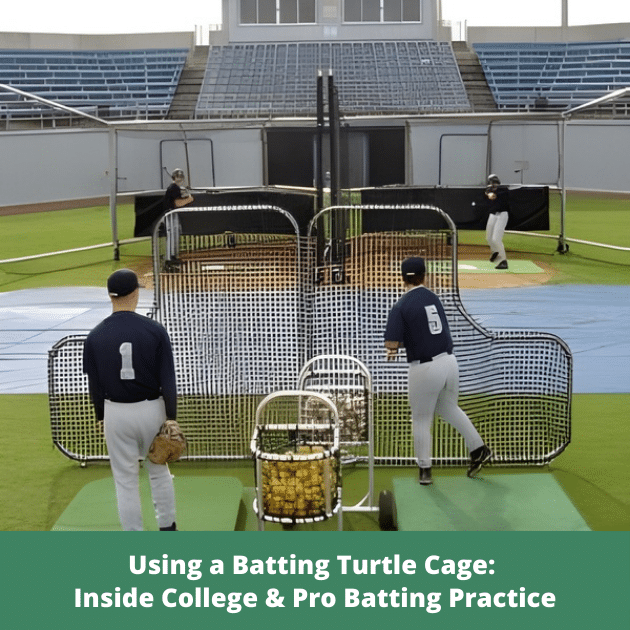
TL;DR: College and pro teams build on-field batting practice around a batting turtle cage positioned over home plate. It keeps pitchers safe, gives coaches clear sightlines, and lets hitters track real ball flight. Your program can run the same system using portable cages from BaseballTurtles.com.
What Is a Turtle in Baseball?
A turtle in baseball is a portable, dome-shaped or arched batting cage that rolls directly over home plate so hitters can take live swings while foul balls and errant pitches are contained within the structure. Coaches and pitchers stay protected without blocking the hitter’s view of the outfield, which makes it possible to track real ball flight on every rep. The name comes from the cage’s low, rounded shell-like profile that covers the batter’s box and the pitcher’s area during batting practice.
At the college, minor league, and professional level, the batting turtle cage is the standard piece of equipment at the center of every on-field hitting session. It is not a stationary tunnel. It moves on wheels, sets up in minutes, and clears the field just as fast.
The Pitch Hunter Baseball Batting Turtle is the heavy-duty option built for daily use at competitive programs. It is designed for years of high-volume work at the college, MiLB, and MLB level.
Batting Turtle vs. Traditional Batting Cages: Which Is Best for Your Team?
A batting turtle is the better choice for any program running on-field batting practice because it moves with your team, preserves game-like hitting conditions, and gives coaches an unobstructed view that a fixed tunnel cannot provide. Traditional full-length tunnels are useful for indoor facilities or isolated mechanical work, but they limit ball-flight evaluation, slow down transitions between hitters, and cannot follow your team onto the field.
| Factor | Batting Turtle Cage | Traditional Full-Length Tunnel |
|---|---|---|
| Portability | Rolls to any field position in minutes | Fixed or requires major assembly |
| Ball flight evaluation | Full outfield visibility on every swing | Blocked by netting at the end |
| Coach-to-player communication | Coach stands alongside, clear sightlines | Coach often separated by netting or distance |
| Game-like conditions | Hitter sees real field, real depth | Enclosed environment changes perception |
| Transition speed | Next hitter steps in within seconds | Slower changeovers, netting repositioning |
| Foul ball containment | Strong, designed specifically for this | Strong but fixed in place |
| Multiple simultaneous stations | Yes, pair with side cages | Limited by fixed footprint |
| Best use case | On-field BP, live pitching, game prep | Indoor mechanical work, tee drills |
Programs that run serious on-field batting practice use turtle-style cages because the setup mirrors what happens in a real game. The Pitch Hunter Batting Turtle gives you that game-like environment along with the structural durability to handle daily use across a full season and beyond.
How to Protect Pitchers During Batting Practice
The most reliable way to protect pitchers during batting practice is to position a heavy-duty batting turtle cage over home plate so that line drives and foul balls are stopped before they reach the mound. The turtle’s arched netting wraps around the pitcher’s release zone and deflects batted balls before any fielder or coach is at risk. This is the exact system used by D1 college programs, MiLB teams, and MLB organizations every day of the season.
Beyond the main cage, programs add:
- A protective L-screen or secondary screen directly in front of the pitcher for live BP situations where a pitcher throws from inside the cage structure
- A portable backstop behind home plate to catch passed balls and wild pitches during machine or front-toss work
- Side screens to protect base coaches or fielders standing near the line during live rounds
The Sandlot Portable Baseball Backstop works well as a secondary containment screen for stations running behind the main turtle cage. It sets up quickly and handles heavy contact from daily use.
The key principle is layered protection: the batting turtle handles the primary threat from hard-hit balls, and secondary screens cover the gaps. When every station is protected, coaches can focus on instruction instead of safety management.
How the Baseball Hitting Turtle Can Improve Your Swing
A batting turtle improves your swing because it puts you in a real hitting environment where you see actual ball flight, get immediate coach feedback, and take high-volume reps without the interruptions that come with switching between setups. The open-field view from inside a turtle cage forces hitters to read the ball the same way they do in a game, which builds better pitch recognition and contact quality over time.
Specific ways the turtle cage improves your swing mechanics:
- Barrel path feedback is immediate. Coaches standing alongside the cage see the full swing from setup through extension and can make corrections pitch by pitch.
- Opposite-field work becomes measurable. With full outfield visibility, coaches can confirm whether the ball is actually going the other way or just feeling like it.
- Gap work and situational hitting are realistic. Hitters aim for actual targets on the field instead of a net 70 feet away.
- Volume is higher. Faster transitions between hitters mean more swings per session, and more quality swings build better habits faster.
- Mechanical refinement happens in context. Adjustments made during live BP inside a turtle cage transfer to games more reliably than adjustments made in a tunnel.
The Foldable Batting Cage Batting Turtle is a strong option for programs that need to maximize rep volume while keeping setup and breakdown time short between sessions.
How to Use a Hitting Turtle to Build Better Bat Speed
You build better bat speed with a hitting turtle by using its contained, game-like environment to run focused velocity rounds where every swing is a max-effort, full-extension rep tracked against real ball flight. The turtle cage removes the distractions and safety concerns of open BP so hitters can concentrate entirely on explosiveness through the zone.
A bat speed development round inside a turtle cage looks like this:
- Round 1: Timing work. Hitters sync up against velocity before trying to do anything aggressive. This round primes fast-twitch response.
- Round 2: Power zone focus. Pitches in the middle third of the plate, hitter is cleared to go all out through contact. Coach watches hip rotation and hand path from outside the cage.
- Round 3: Opposite-field speed. Bat speed means nothing if you can only pull the ball. This round trains the hitter to generate the same explosion to the opposite field.
- Round 4: Gap work. Line drives to the alleys require the same bat speed as pull power but with better contact timing. Tracking to the outfield is only possible because the turtle is open on the field side.
- Round 5: Situational. Full-count, runner on third, game-pressure reps. Speed under pressure is real bat speed.
The Roll-Away Batting Cage from Baseball Turtles is built to handle this kind of high-intensity daily work. It rolls into position, takes the abuse of max-effort swings, and stores quickly when the session ends.
For programs running simultaneous stations to double total swing volume per session, the Singles Hitter Portable Batting Cage creates a full hitting lane without the footprint of a second full turtle. Set it up alongside the main cage and run two hitters at once.
How Pro and College Teams Set Up the Field
The standard on-field setup begins with the batting turtle rolled over home plate so the hitter has a full view of the outfield. From there, coaches add supporting equipment based on how many simultaneous stations the session requires.
Here is how a typical multi-station setup is organized:
Station 1: Main Turtle Cage Over Home Plate
This is the foundation of every session. The turtle cage is used for:
- Live BP
- Front toss
- Timing work
- Mechanical refinement
- Situational hitting
The cage protects coaches and pitchers, contains foul balls, and stays mobile so field crews can clear it in under two minutes when the session ends. The Pitch Hunter Baseball Batting Turtle is the pro-grade option for this primary station.
Station 2: Auxiliary Backstop or Secondary Cage
For tee work, soft toss, or drill stations running at the same time as main cage BP, teams add a secondary structure. The Sandlot Portable Baseball Backstop handles this role well. It is compact, portable, and built for daily field use.
Station 3: Side Hitting Lane
Pro programs frequently run two to four simultaneous hitting stations to maximize total reps per session. The Singles Hitter Portable Batting Cage creates a long hitting lane for this purpose without requiring a second full turtle.
Early Work and Pre-BP Stations
Before team BP starts, coaches often run individual mechanical work. For this, a compact cage that surrounds home plate but leaves the field open works best. The Home Plate Portable Hitting Cage is built for this exact use. It gives you rapid reps without any major setup time.
How Coaches Run a Real BP Session
Below is the session structure used by D1, MiLB, and MLB programs. Every phase builds on the one before it, and the batting turtle cage is present through all of them.
Phase 1: Early Work
Individual 1-on-1 instruction before the full team arrives. Stations include tee work, opposite-field soft toss, barrel path corrections, and timing drills. A compact cage handles this phase.
Phase 2: Warm-Up and Field Prep
While hitters stretch, field crews roll the turtle cage into place over home plate. The Foldable Batting Cage Batting Turtle makes this fast with heavy-duty wheels and a durable frame. Crews confirm cage alignment with home plate, screen positions, and ball bucket placement before the first hitter steps in.
Phase 3: Hitting Rounds
Teams typically run four to five hitting rounds per hitter:
- Round 1: Timing work, getting synced to velocity
- Round 2: Opposite-field focus
- Round 3: Gap work, line drives to the alleys
- Round 4: Power round, full-effort swings to the pull side
- Round 5: Situational hitting, game-count and game-scenario reps
While one hitter works in the main turtle cage, others cycle through secondary stations. This keeps everyone active and maximizes total reps per session.
Phase 4: Breakdown
The turtle cage rolls off the field on its wheels. Secondary screens fold and store. With quality portable equipment, this takes less than five minutes. The field is ready for fielding work, base running, or another group almost immediately.
Quick Recap
- A batting turtle is a portable, dome-shaped cage that rolls over home plate for on-field batting practice.
- College and pro teams prefer turtle cages over full tunnels because they preserve game-like ball flight and give coaches clear sightlines.
- The primary turtle cage sits over home plate. Secondary cages and backstops create additional simultaneous stations.
- Pitcher and coach protection comes from the turtle’s arched netting plus auxiliary screens like the Sandlot Portable Backstop.
- Bat speed development and swing improvement happen faster in a turtle cage because every rep is a game-condition rep with real ball flight to evaluate.
- A complete pro-style setup uses one main turtle plus one or more side cages to double or triple total swings per session.
- Quality portable equipment sets up and breaks down in minutes, keeping session tempo high and field transitions fast.
- Every product your program needs is available at BaseballTurtles.com.
Frequently Asked Questions
What does a batting turtle cage cost compared to a traditional tunnel?
Batting turtle cages vary in price depending on size and construction. The investment is typically comparable to a quality full-length tunnel, but the turtle delivers more value for on-field programs because it is portable, durable, and serves multiple functions across live BP, front toss, and situational hitting. Contact Baseball Turtles directly to discuss which option fits your program’s budget and usage volume.
How many hitters can a batting turtle setup handle per hour?
A single turtle cage over home plate with one side station running simultaneously can cycle through significantly more hitters per hour than a single tunnel because transitions take seconds instead of minutes. Pro programs regularly move an entire lineup through four to five rounds per hitter in a 45-to-60-minute window using this layout.
Can a batting turtle be used on both baseball and softball fields?
Yes. Batting turtle cages work on any dirt or turf surface. They roll on wheels and are not anchored to the ground, so moving between a baseball diamond and a softball field takes the same amount of time as any other relocation. Check product dimensions at BaseballTurtles.com to confirm the right size for your specific field setup.
How do you store a batting turtle when it is not in use?
Most batting turtle cages fold or collapse for compact storage. The Foldable Batting Cage Batting Turtle and the Roll-Away Batting Cage are both designed for programs that need to store equipment in a limited footprint between sessions. Field crews can break them down and move them to storage without tools.
What is the difference between the Pitch Hunter and the other Baseball Turtles cages?
The Pitch Hunter is the heavy-duty, pro-level option built for years of daily use in high-volume programs. Other cages in the Baseball Turtles lineup, like the Singles Hitter and the Home Plate Portable Hitting Cage, are designed for secondary stations or programs with different space and budget requirements. A Baseball Turtles product specialist can walk you through which cage matches your specific session structure.
Do batting turtles hold up to daily use at the high school level?
Yes, when you choose a cage built for competitive use. Budget options wear out quickly under daily batting practice. The cages available through BaseballTurtles.com are built for programs that run serious BP every day, from high school through the professional level. Durability and long-term value are the reason decision-makers at competitive programs choose them over cheaper alternatives.
How is the batting turtle positioned correctly over home plate?
The cage rolls directly over home plate so the hitter stands in the normal batter’s box position inside the structure. The open end faces the outfield so ball flight is visible on every swing. Coaches confirm alignment before the first round starts by checking that the plate is centered under the cage frame and that the pitcher or toss feeder has a clear, protected lane to deliver the ball.
Ready to Build a Pro-Style BP Setup?
Baseball Turtles works with programs at every level across the United States. Whether you are outfitting a high school program, a college facility, or a professional organization, a Baseball Turtles specialist can help you match the right cage to your field, your session structure, and your budget.
Give us a call at 828-820-8644
Or browse the full lineup at BaseballTurtles.com.